
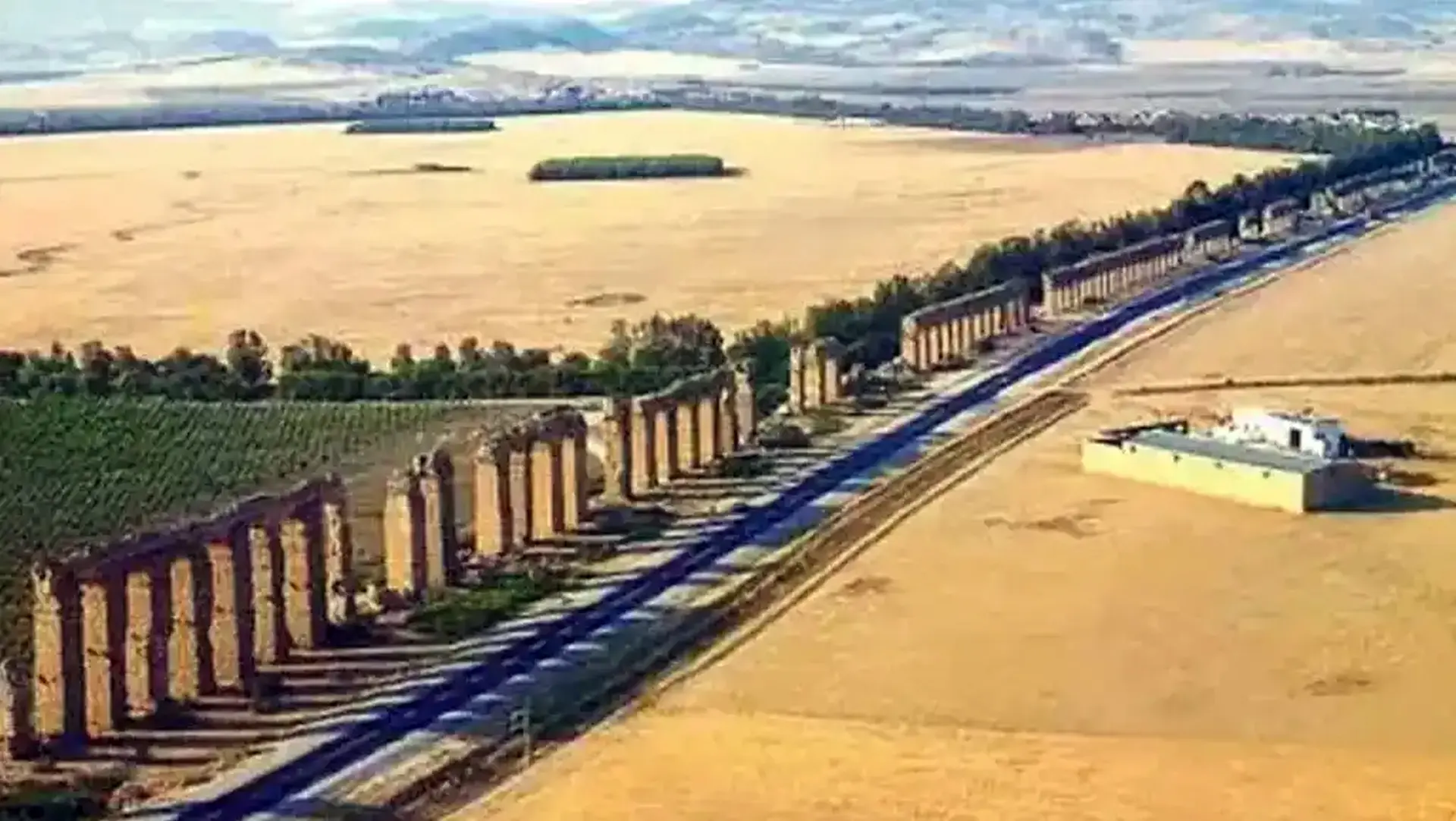
The Zaghouan Aqueduct

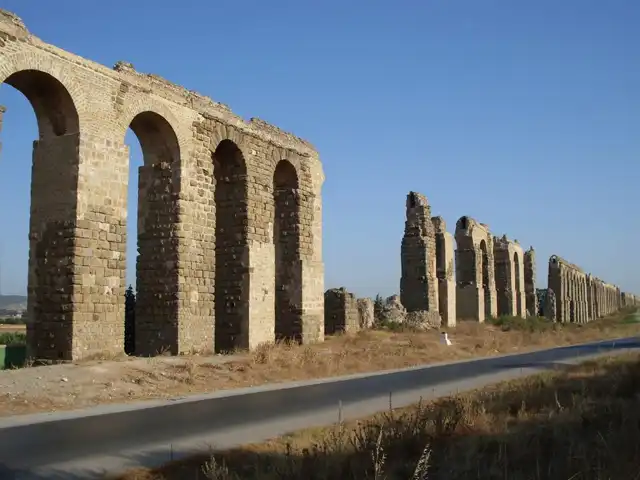


The Zaghouan aqueduct, the Roman one that brought water from Zaghouan to Carthage, remains an impressive work. Built during the reign of Emperor Hadrian, between 120 and 131, this aqueduct has known many adventures.
Demolished by the Vandals in 409, it was rebuilt by Belisarius in 534. The work was again cut during the siege of Carthage by the Arabs in 698. It will then be restored by the Fatimids in the tenth century and then enlarged and consolidated by the Hafsids who built diversions in the thirteenth century.
You can still admire the high columns of this architectural masterpiece at the level of Bardo in Tunis but also in the region of Mohammedia and Oudna, going towards Zaghouan where the source of this thousand-year-old aqueduct is located.
It is near Mohammedia that the building is most spectacular, with high piles joined by arches. When it crosses Oued Meliane, the aqueduct reaches more than twenty meters in height.
By observing it closely, one can notice that the methods of construction of the aqueduct are very variable. Some are in brick, others in adobe or blockage. These variations provide information on the many restorations of this building which leads to the cisterns of the Malga in Carthage and remains one of the jewels of antiquity in Tunisia.
This impressive construction, from the time of Hadrian (120 AD), connected the Water Temple of Zaghouan to the city of Carthage over 123 km. From its construction, the catchment of the source was intended for the water supply of Carthage. It was therefore necessary to convey the water to the city. Thus, colossal works were undertaken.
So imagine:
– A total of 132 km of network, sometimes aerial (aqueduct), sometimes underground
– Two ramifications: one coming from Zaghouan, the other from Aïn Jouggar, further south
– Four springs captured: two in Zaghouan, two in Aïn Jouggar
– A flow estimated at 30,000m3/day produced in the 2nd century, reused in the 10th, 13th and 19th centuries. Some portions are still used today.
The Zaghouan Aqueduct in Video
Where to Find The Zaghouan Aqueduct
Frequently Asked Questions
Everything you need to know before visiting
The Zaghouan Aqueduct was built between 120 and 131 AD under Emperor Hadrian. It stretched approximately 132 kilometres from its source at the Water Temple in Zaghouan to the cisterns of Carthage, making it one of the longest aqueducts in the Roman world.
At its peak the aqueduct delivered an estimated 30,000 cubic metres of water per day to Carthage, supplying the Antonine Baths, public fountains, private homes, and industrial uses across the city.
The Vandals damaged the aqueduct in 409 AD, interrupting Carthage's water supply. It was repaired under the Byzantines and again partially restored in later centuries. Sections of the arched structure remain standing along the route today, some reaching more than 20 metres in height.
Yes. Remarkably, sections of the ancient channel were incorporated into later water management systems, and some portions continued to carry water into the modern era.
The most impressive surviving arches can be seen near the town of Mohammedia, south of Tunis, where a long run of the elevated structure crosses an open valley. The source end is the Water Temple in Zaghouan town.
Sections of the aqueduct are accessible from the road, and the Water Temple in Zaghouan is open to visitors. There is no formal long-distance walking route along the full length, but the most photogenic arched sections near Mohammedia are easy to reach by car.
