


The city of Kairouan lies in central Tunisia, 150 km southwest of Tunis and 50 km west of Sousse. With 139,070 inhabitants (2014), it is the fourth holiest city in Islam and the first holy city in the Maghreb. Founded in 670, Kairouan was the first Arab city in North Africa. It became a major Islamic center in Ifriqiya until the 11th century. UNESCO listed its medina on the World Heritage List in 1988. In 2009, the Islamic Organization for Education, Science and Culture proclaimed it the capital of Islamic culture.
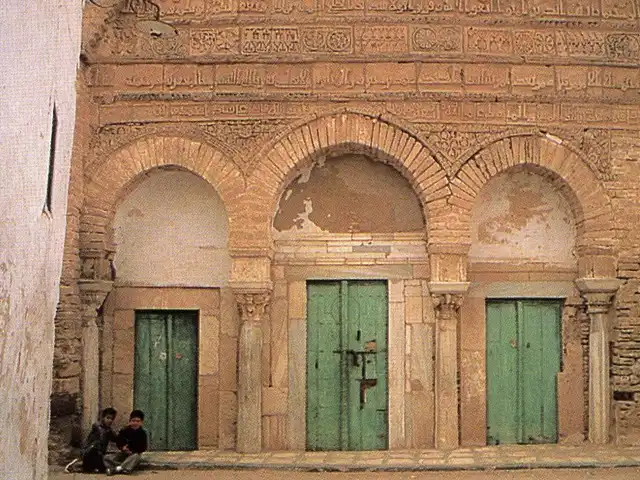
Kairouan flourished under the Aghlabid dynasty in the 9th century. Despite Tunis becoming the political capital in the 12th century, Kairouan remained the Maghreb’s first holy city. Its rich heritage includes the Great Mosque, with its marble and porphyry columns, and the Three Doors Mosque, dating from the 9th century. The city is also famous for its handmade wool carpets and pastries, including makroud.
The City of Kairouan : Heritage and Urban Planning
The medina (54 ha) and its suburbs (20 ha) form a complete Arab-Muslim city. Narrow, winding streets separate juxtaposed dwellings. Ramparts over three kilometers long surround the medina. The Great Mosque is an architectural masterpiece that served as a model for several mosques in the Maghreb. The Three Doors Mosque features the oldest carved facade in Muslim art. The Aghlabid Basins, dating from the 9th century, supplied water to the city. The Zawiya of Sidi Sahbi houses the remains of a companion of the Prophet Muhammad.
The historic ensemble has preserved its urban fabric without alteration. Thirty-six monuments have specific classification as historical monuments. The National Heritage Institute ensures safeguarding and management. A buffer zone protects the three components of the World Heritage property. Ultimately, the city of Kairouan offers an unforgettable journey into Tunisia’s Islamic heritage.
The City of Kairouan in Video
The City of Kairouan on the Map
Map data © OpenStreetMap contributors
Where to Go in The City of Kairouan
Click on any place to discover it, or visit its full page.




You came for the sun. You'll stay for the soul.
Let us show you what Tunisia truly is
