

The Barber Mosque (Sidi Sahbi)
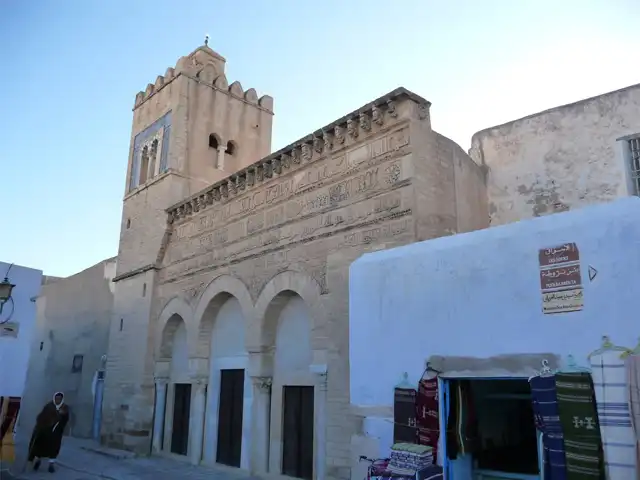
The zaouia of Sidi Sahbi, covered with tiles and carved stucco, outside the medina of Kairouan
Discover the place
The Barber Mosque is one of the most beautiful monuments of Kairouan. In fact, it is not a mosque but a zaouia, a sanctuary built around the tomb of Abu Zama el-Balawi, a companion of the Prophet Muhammad who died in battle in the 7th century. Locals call him Sidi Sahbi, and many consider him the patron saint of the city.
Why the Barber Mosque?
According to tradition, Abu Zama always carried with him three hairs of the Prophet's beard. For this reason, visitors nicknamed the place the Barber Mosque. Today, it remains a place of deep respect, and many families come here to pray or to celebrate important moments.
A sanctuary rebuilt by the Mouradite beys
The first buildings probably date from the 13th and 14th centuries. However, the complex you see today comes mostly from the 17th century. Around 1662, Hammouda Pacha Bey rebuilt the zaouia and added a madrasa and the minaret. Later, his grandson Mohamed Bey redid the dome of the mausoleum and probably the courtyard with its galleries. In the 19th century, the French writer Guy de Maupassant visited it and wrote with wonder about its shining tiles.
Inside the Barber Mosque
First, you enter a large courtyard paved with bricks and surrounded by arcades. In one corner rises a minaret in Andalusian style, decorated with ceramic panels. Then a door framed by white and red marble leads to a bent corridor. Finally, you reach a courtyard covered with tiles and carved stucco, in front of the room of the tomb. The colours, the light and the silence create a peaceful atmosphere.
Visiting tips
Non-Muslim visitors can usually see the courtyards, but not the room of the tomb. Dress modestly, with shoulders and knees covered. Allow about forty-five minutes. Then continue to the Aghlabid Basins nearby and to the medina. For more on the city, see the Kairouan page on Wikipedia.
In short, the Barber Mosque is one of the most refined places of Kairouan, a quiet jewel of tiles and stucco.
Not to be missed
- The zaouia of Sidi Sahbi, companion of the Prophet Courtyards covered with tiles and carved stucco A minaret in Andalusian style Rebuilt by the Mouradite beys in the 17th century A short walk from the Aghlabid Basins
Practical information
- Period
- Rebuilt in the 17th century on older foundations
- Location
- Outside the medina walls, Kairouan
In pictures


On video
Where is it?
Frequently asked questions
Not exactly. It is a zaouia, a sanctuary around the tomb of Sidi Sahbi, with a madrasa and courtyards.
Abu Zama el-Balawi, a companion of the Prophet Muhammad who died in battle in the 7th century.
Tradition says he carried three hairs of the Prophet's beard with him.
Mostly in the 17th century, under the Mouradite beys, on older foundations.
Usually the courtyards, but not the room of the tomb.
Modest clothes, with shoulders and knees covered.
The Aghlabid Basins and the medina of Kairouan.


Nine UNESCO World Heritage sites in Tunisia.
Discover Tunisia's heritage with an expert local guide
