
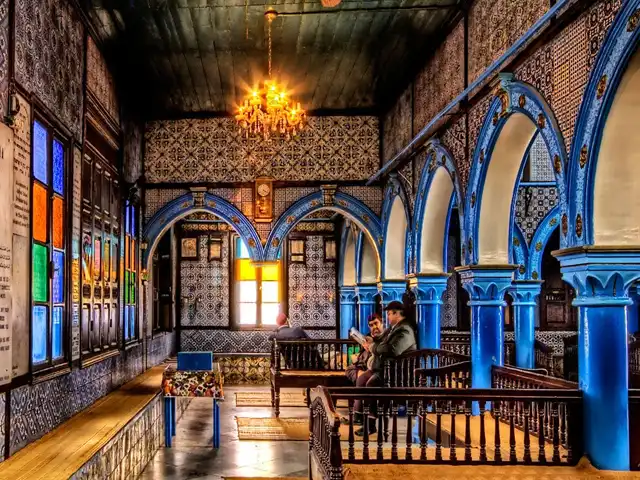
The Ghriba Synagogue


The Ghriba Synagogue is a Tunisian synagogue that is one of the main identity markers of the Jews of Djerba, one of the last living Jewish communities in the Arab world.
The village where it is located, also known as Hara Sghira (“little quarter”), is home to a Jewish community of several hundred people. This establishment is also known as Dighet, a name derived from a Berber variant of the Hebrew word meaning “gate”.
The establishment is the subject of an annual pilgrimage, on the occasion of the Jewish holiday of Lag Ba’omer, bringing together several thousand pilgrims. It is also one of the main tourist attractions of the island of Djerba.
The reputation of the synagogue is based on the many traditions and beliefs that emphasize its antiquity and the fact that it contains remains of Solomon’s Temple. Historically, the pilgrimage brought together members of local communities and more broadly the Jews of Tunisia and neighboring Libya. With the departure of Jews from Arab countries, visitors come mainly from France.
Like the six other ghriba scattered across the Maghreb, it stands isolated in the open countryside, one kilometer from the village of Erriadh, named Hara Sghira (small quarter, one of the two Jewish villages on the island and which t was inhabited until the 20th century only by Cohanim, which, according to local legends, corroborates the fact that the Ghriba was founded by priests who came from Jerusalem.There are five synagogues there, but in order to maintain the preeminence of In the Ghriba, tradition dictates that the Torah scrolls used there are kept at the Ghriba where they are brought in procession.
Historically, it is difficult to determine at what time the fame of Ghriba exceeded the original framework of Djerba. From the second half of the 19th century, we see testimonies appearing emphasizing its sacred character, recognized beyond the Jewish community by Muslims. The synagogue attracts ever-increasing numbers of pilgrims from Tunisia and neighboring Libya. It is possible that the emigration at this time of Djerbian Jews to these regions contributed to the spread of the pilgrimage.
We know from the testimony of Slouschz, who visited the site at the beginning of the 20th century, that the building was enlarged in the 1860s or 1870s with the help of “tumular stones that were found in the cemetery near the walls of the holy house”. He himself describes the building as a “square building, rather sober in appearance and totally lacking in style. Inside, dark corridors precede a square nave with an “Almenor” in the middle, and at the top a gallery supported on columns: nothing particular, characteristic”.
However, with subsequent renovations and alterations to the building, the number of windows has increased. The later modifications are particularly evident on the north side of the building where they caused changes from the building’s original symmetrical plan. The inner courtyard is surrounded by covered loggias built on vaults and columns. Adjacent buildings serve as accommodation for pilgrims, the oldest having been erected in the late 19th century and followed by a second structure established in the early 1950s. Namely, like other synagogues in Djerba, the Ghriba is located near an ancient Jewish cemetery.
The Pilgrimage
An annual pilgrimage, which takes place at the Ghriba on the 33rd day of the Omer, brings together the Jews of North Africa. The festivities begin on Iyar 14 for the commemoration of Rabbi Meir Baal HaNess and continue until Iyar 18 (Lag Ba’omer holiday), the day of remembrance of Rabbi Shimon bar Yohai locally known as Rabbi Shem’un. The pilgrimage includes a visit to the synagogue, almsgiving, prayers and participation in one of the two processions that take place during the last two days of the pilgrimage.
The Jews of Djerba, like foreign pilgrims, mingle inside the synagogue. It is also the only occasion where there is no separation between men and women. In the 1990s and 2000s, most pilgrims came from abroad. According to another local custom, women lay eggs marked with the name of an unmarried girl on a vault marking the spot where, according to tradition, the girl’s body was found. The egg, left by a candle for the duration of the festival, is then returned to the spinster who, after eating it, would be sure to find a husband.
The Ghriba Synagogue in Video
Frequently Asked Questions
Everything you need to know before visiting
El Ghriba is one of the oldest synagogues in the world and one of the last centres of a once-thriving Jewish community in the Arab world. Located in the village of Hara Sghira on Djerba, it is a pilgrimage site for Jews from Tunisia and the diaspora.
The Lag Ba'omer pilgrimage takes place 33 days after Passover, typically in May. Thousands of Jewish pilgrims from Tunisia, Europe, Israel, and beyond gather for prayers, music, and a candlelight procession.
According to tradition, the site was chosen because a sacred stone fell from the sky or was brought by priests fleeing Jerusalem after the destruction of the First Temple. The name "Ghriba" means "the strange" or "the miraculous" in Arabic.
The interior is beautifully decorated with blue and white tiles, stained glass, ornate wooden benches, and silver Torah scroll cases. A sacred inner chamber houses ancient Torah scrolls and relics said to date back millennia.
Yes, non-Jewish visitors are welcome during opening hours outside prayer times. Men are required to wear a kippah (available at the entrance). Modest dress is expected of all visitors.
The current building dates from enlargements carried out in the 1860s and 1870s, replacing an earlier structure. Security has been reinforced since a terrorist attack at the site in 2002.
