
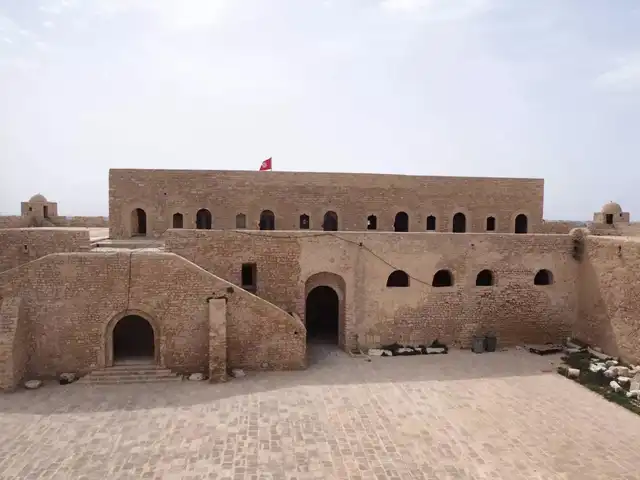
Borj el Kebir The Ottoman Fort


The Ottoman fort, also called Kasbah, is a fortress erected at the end of the 16th century. It stands on the site of a former Fatimid palace. This fortress is considered one of the finest specimens of Ottoman military architecture in Tunisia. The building follows a quadrangular plan. Later, the builders added corner bastions. A powerful wall surrounds the structure. Originally, only one entrance pierced the wall. After its reassignment as a prison, a second access was added in the 19th century.
The main door leads to a vaulted and bent passage. This passage opens onto a courtyard. Vaulted rooms surround this courtyard. At the southeast corner, an oratory of earlier construction survives. The builders integrated it into the building. From the terraced walkway, visitors enjoy a beautiful view of Cap Mahdia’s end. The basin of an ancient port lies closer to the monument. Some specialists date this port back to the Punic period.
The Ottoman Fort, Borj El Kebir, panoramic views, and visiting hours
From the Great Mosque, take the road to the sea. Head towards the ruins of the old arsenal basins and the emir’s palace nearby. The imposing mass of Borj el Kébir rises before you. Climb onto the terrace. You will admire a beautiful view dominating the whole city.
Visiting Hours
Open every day.
Mid-September to March: 9:00 AM – 4:00 PM
April: 9:00 AM – 6:00 PM
May to mid-September: 9:00 AM – 7:00 PM
Entrance Fees
Entrance: 7 TND
Photo rights: 1 TND
Ultimately, the Ottoman Fort offers an unforgettable journey into Mahdia’s rich military and architectural heritage.
Borj el Kebir The Ottoman Fort in Video
Where to Find Borj el Kebir The Ottoman Fort
Frequently Asked Questions
Everything you need to know before visiting
Borj el Kebir, meaning "the Great Fort," is a late 16th-century Ottoman military complex built on the site of the earlier Fatimid caliph's palace in Mahdia. It is considered one of the finest examples of Ottoman military architecture in Tunisia.
The fort was built by the Ottomans to consolidate their control over the strategic coastal city of Mahdia after taking it from the Spanish in 1574. It replaced the ruins of the Fatimid palace that had stood on the same site for centuries.
Visitors can explore the ramparts, towers, and interior spaces of the fort, which provide panoramic views of the sea and the old medina of Mahdia. The fort occasionally hosts cultural events and exhibitions.
Entry costs approximately 7 TND, with an additional 1 TND charge for photography. Opening hours follow the standard Tunisian heritage site schedule.
Together with the Skifa Kahla gateway and the Fatimid Mosque, Borj el Kebir forms a trio of major monuments that chart Mahdia's history from its 10th-century Fatimid founding to its centuries under Ottoman rule.
No. There are several forts called "Borj el Kebir" in Tunisia. The one in Mahdia is a distinct Ottoman structure, while the similarly named fort in Houmt Souk on Djerba (Borj Ghazi Mustapha) has different origins and history.
