
About This Site
The archaeological site Gigthis lies in southern Tunisia, in the governorate of Medenine. It sits between Djerba and the Medenine peninsula, 1 km south of Sidi Salem Boughrara. The site covers 60 hectares. It lies on the ancient road linking Carthage to Leptis Magna.
Gigthis, Punic origins, Roman prosperity, and Byzantine citadel
Victor Guérin first identified the site in 1860 through two inscriptions. Gigthis belonged to Carthage in the 6th century BC. It developed an urban fabric by the 1st century. However, it only became a municipality in the 2nd century under Antoninus Pius. The city then prospered economically.
Two Punic-Roman necropolises and a Byzantine fortress bound the city to the north. The sea lies to the east. A temple of Mercury dominates the southeast. The city became a Numidian territory under Massinissa in the 2nd century BC. It later became part of Africa Nova, then Tripolitania.
Gigthis stood at the crossroads of main routes. It prospered and became a municipality under Antoninus Pius (138-161). The city served as an episcopal seat in Christian times. The Byzantines built a citadel in the 6th century. By 1307, Gigthis lay in ruins. The Islamic period left few traces.
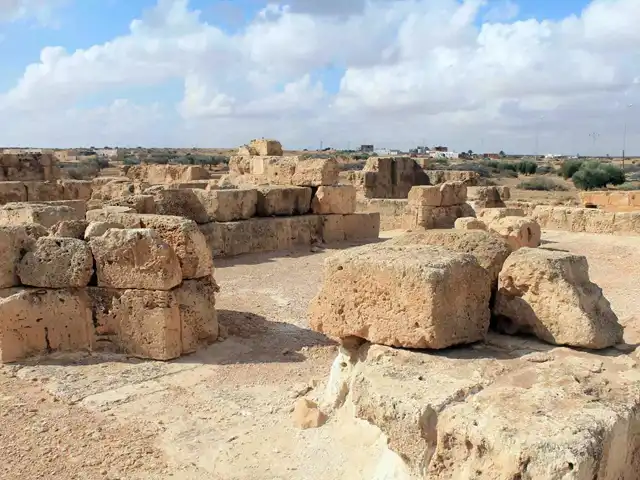
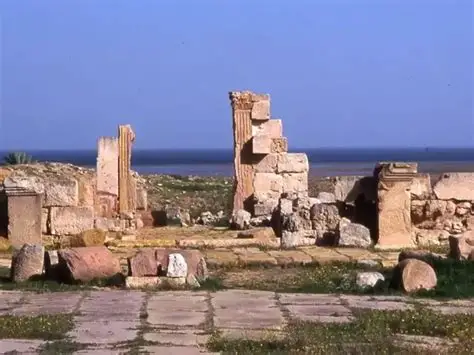
The Roman forum stands in the center. The capitol is the most important building nearby. Remains of dwellings with mosaic corridors also survive. Recent restoration campaigns have cleared and highlighted the site’s components.
Good to Know
Opening Hours: Sep 16–May 31: 9:30 AM – 4:30 PM. Jun 1–Sep 15: 8:00 AM – 12:00 PM / 4:00 PM – 7:00 PM. Ramadan: 9:00 AM – 4:00 PM.
Entrance Fee: 5 TND
Remarks: Closed on Fridays.
Amenities: Bathroom, Shop, Cafeteria
Archaeological site of Gightis in Photos



Where to Find Archaeological site of Gightis
Discover in Video
Frequently Asked Questions
Gightis was a Carthaginian trading post turned Roman city, situated on the Gulf of Bou Grara in the Medenine governorate of southern Tunisia. The site covers approximately 60 hectares and preserves remains spanning from the 6th century BC Carthaginian period through to Byzantine times.
The site preserves a Roman forum, a Capitol temple with standing columns, a Temple of Mercury, porticoed streets, thermal baths, and a harbour area. The combination of Punic foundation and well-developed Roman civic architecture makes Gightis unusual for the deep south of Tunisia.
Gightis is one of Tunisia's least-known major archaeological sites, receiving very few visitors despite its size and quality. For archaeology enthusiasts travelling in the south, it offers an uncrowded experience of a substantial ancient city.
Entry is approximately 5 TND. There is no on-site museum, but finds from the site are displayed in national and regional museums.
Gightis is located near the village of Bou Grara on the Gulf of Bou Grara, about 25 km north of Zarzis and about 50 km from Medenine. A hire car is the most practical option. The site can be included in a circuit of southern Tunisia combining Djerba, Zarzis, and Medenine.
Gightis was a key port in the trans-Saharan and Mediterranean trade network, handling goods from the interior of Africa (including elephants and slaves in Punic times, and gold, ivory, and spices in the Roman period) and distributing Mediterranean products southward.
