
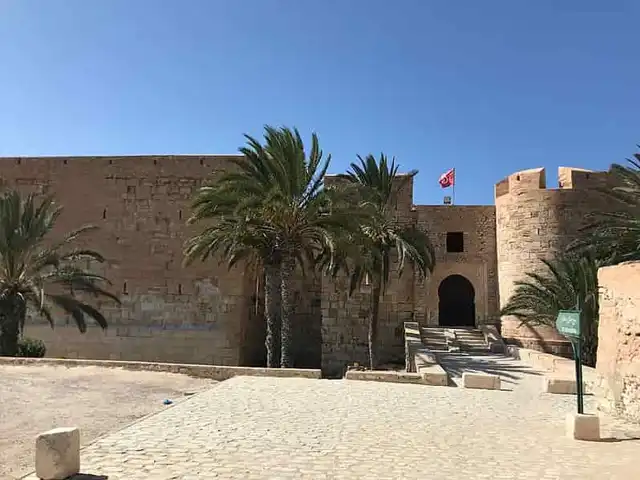
The Spanish Fort Borj Ghazi Mustapha


The Spanish Fort Borj Ghazi Mustapha in Djerba, also called Borj El Kebir is a fort adjoining the fishing port of Houmt Souk, capital of the island of Djerba.
This defensive structure was built by Roger de Loria, Admiral of Aragon and Sicily in 1289 on the site of a Roman stronghold, the remains of which were reused in the construction of the structure. This was refitted, then reinforced in 1557 by Dragut and frozen in its current configuration by a Spanish garrison of 6,000 soldiers who came, in 1560, to drive out the Turkish corsairs from the island, before being exterminated the same year by the Turkish corsair.
Rectangular in shape, Borj El Ghazi Mustapha is flanked by round and square towers. It was accessed by a drawbridge over a ditch isolating the structure. The entrance door opens onto a vestibule defending access to the inner courtyard which contains the remains of garrisons which have succeeded one another in this enclosure since Antiquity. A room, converted into an antiquarium, houses various objects found on site as well as explanatory panels. The walkways, for their part, offer a superb view of the surroundings and the open sea.
Opening Hours:
From 16/09 to 31/05: 09.30 – 16.30
From 01/06 to 15/09: 08.00 – 19.00
Ramadan hours:
9:00-17:00
Entrance fees
8 TND
Notice:
Closed on Friday
The Spanish Fort Borj Ghazi Mustapha in Video
Where to Find The Spanish Fort Borj Ghazi Mustapha
Frequently Asked Questions
Everything you need to know before visiting
The fort was originally built in 1289 by Roger de Loria, Admiral of Aragon and Sicily, to control the island of Djerba. It was later reinforced and expanded by the Ottoman admiral Dragut (Turgut Reis) in 1557.
In 1560 the fort was the site of a major Ottoman victory over a Spanish-led Christian fleet. After the battle, Ottoman forces used the skulls of the fallen to construct a macabre pyramid on the shore; a replica of this skull tower still stands near the fort.
Inside the fort is a small antiquarium housing local Roman and medieval artefacts, including amphorae, inscriptions, and ceramic finds from the Djerba area. The ramparts and towers also offer views over Houmt Souk and the sea.
The fort is located at the port of Houmt Souk, the main town of Djerba. Entry costs approximately 8 TND. Opening hours follow standard Tunisian heritage site schedules.
The name reflects the Spanish-Aragonese origins of the original 1289 construction by Roger de Loria, who was acting under the authority of the Spanish crown's Aragonese maritime empire.
The fort is within walking distance of Houmt Souk's central market and ferry terminal. Djerba is connected to the mainland by a road causeway from Zarzis and by a ferry from Jorf, as well as by flights to Djerba-Zarzis International Airport.
